The Age of the Forward Deployed Engineer
A founder’s guide to what FDEs do, who to hire, and whether you need one

Why Founders Keep Hearing This Term
You have probably heard the term “Forward Deployed Engineer” in conversations with other founders, or in a board meeting recapping how a large customer got signed and then scaled. The story often starts with the same character: a brilliant engineer who was there at the right moment to step in and help, with a deep understanding of the customer’s business and their tech stack.
If you are a founder, that story raises three fair questions. What does that person actually do, day to day, beyond “being brilliant and being there”? What should you look for if you decide to hire one? And, the hardest question, does your company even need one, or is this an expensive habit borrowed from companies with very different economics than yours?
This article answers those three questions directly, for founders who are deciding whether and how to build this function. It is not a general explainer of enterprise software. It is meant to help you make a hiring and org-design decision.
For thirty years, the gap between “the product as shipped” and “the customer’s actual, messy business” was filled by consultants, implementation partners, internal IT teams, and pre-sales engineers. Each owned part of the job, but rarely the entire path from an unclear business problem to a working production solution. A Forward Deployed Engineer (FDE) is what happens when a startup decides to own that entire path itself, in-house, with an engineer instead of a partner network.
What a Forward Deployed Engineer Actually Does
While the words “bespoke solution” or “customization” are enough to give a founder or investor the chills, the reality is that a good FDE solves a business problem in a way that feels uniquely adapted to a customer, without turning your company into a services shop.
They embed into a customer’s workflows. They script, code, connect systems, model data, co-create with operational teams, and deploy something people can actually use, drawing on their experience, their understanding of the customer’s business, and the unique tools and access they get as an employee of the startup they represent.
But their job is not just to build a custom solution. The best FDEs know which part of a customer’s problem is truly unique and which part is likely to repeat across your next ten customers. They turn what they learn in the field into reusable integrations, templates, workflows, product features, deployment playbooks, and clearer product priorities. That is the important distinction for you as a founder: if every deployment is a one-off project, you do not have a scalable software business. You have a services business with very capable engineers. If every deployment helps the next customer go live faster, with less custom work and more confidence, your FDEs become one of the most effective product-discovery engines your company can have.
Their blend of skills has to be carefully balanced: a very good coder, humble enough to understand that the customer’s business takes priority over what their own employer has to sell, but disciplined enough not to build every feature a customer asks for. They listen and learn most of the time. Then they decide what should be configured, what should be built, what should become product, and what should simply not be done.
More Than a Great Demo
This distinction matters even more if your product touches AI. It is now very easy to make something look impressive in a workshop: connect a model to a few documents, wire up a workflow, generate a dashboard, or vibe-code an internal tool in a few hours. The customer sees it and immediately understands the potential.
But a demo is not a deployment. Can it access the right data without exposing the wrong data? Is there an audit trail? Who is responsible when it gets something wrong? Can the customer’s internal team maintain it? Will it still work after the underlying process changes, after a model changes, or after your FDE moves to the next account?
A good FDE does not just create a solution. They make it secure, auditable, scalable, observable, and maintainable. They think about permissions, integrations, data quality, failure modes, monitoring, cost, performance, and handover. In enterprise software, the hard part is rarely getting a prototype to work. The hard part is getting an organization to trust it enough to use it in a meaningful workflow, which is exactly the gap that decides whether your pilot turns into a renewal.
Adoption Is the Real Job
Technology is only one part of an enterprise deployment. A new workflow has an owner. It may affect several teams, change how people make decisions, how they report, who has access to information, or how performance is measured. Some people will be excited about it; others will have very good reasons to be cautious.
Your FDE needs to understand more than the technical stack. They need to understand incentives, internal politics, the actual users, the executive sponsor, and the business outcome that matters. A deployment is not successful because it went live. It is successful when a team uses it repeatedly, trusts it in an important process, and can point to an outcome that improved: less time spent, fewer errors, better decisions, lower costs, faster execution, or higher revenue.
FDE vs. Sales Engineer vs. Solutions Engineer vs. Customer Success Manager
Founders building their first go-to-market team often conflate these four roles — or worse, try to make one early hire do all four jobs at once. They overlap, but they are not interchangeable, and hiring the wrong one for the job you actually need is one of the most common early go-to-market mistakes.
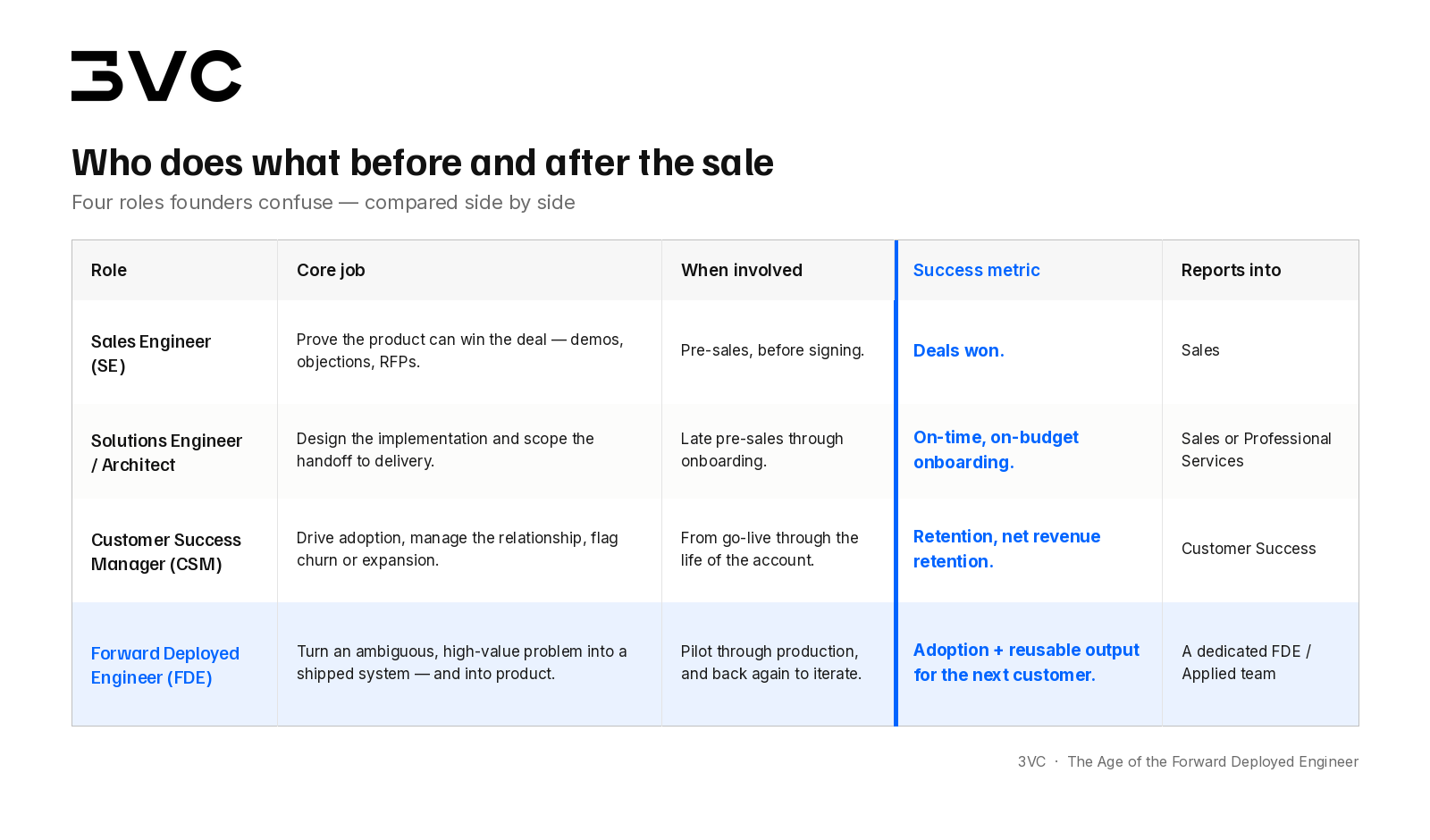
The FDE is the only one of the four who is expected to write production code that ships, and the only one whose success is measured partly by what happens for the next customer, not just the one in front of them today. A sales engineer helps validate the technology before a deal is signed. A solutions engineer scopes and hands off. A customer-success manager drives adoption and renewal after the fact. An FDE sits in the uncomfortable middle: close enough to the customer to understand the real problem, technical enough to solve it, and product-minded enough to make sure the solution teaches the company something reusable.
What to Look for When You Hire One
Because the role sits between engineering, product, and the customer relationship, hiring the wrong profile is expensive and slow to correct. Screen for these traits specifically:
- Full-stack, production-grade engineering ability, not just prototyping skill. They will write code your customer depends on, often on infrastructure you do not control.
- Domain curiosity and humility: willing to spend weeks learning the customer’s business before writing a line of code, and comfortable being corrected by someone who has never written code.
- Product judgment: the discipline to say no to a feature request and configure or template a workaround instead of building everything a customer asks for.
- Communication range: equally credible in a technical deep dive with an engineer and in a business conversation with an executive sponsor.
- Comfort with ambiguity: no scope of work, no clear brief, and the instinct to define the plan rather than wait for one.
- A bias toward generalizing: actively looking for the pattern that will repeat across the next ten customers, and turning it into a template, an integration, or a feature request instead of a one-off.
- Founder or early-startup experience is a strong plus signal: several frontier AI labs explicitly favour former founders or early engineers who have built a product end to end.
Red flags worth screening out: someone who only wants to build and resists listening first; a background purely in delivery or professional services with no product instinct; a strong technologist who cannot present clearly to a non-technical executive; and anyone who treats every customer request as equally worth building.
When Can Your Company Afford One
An FDE should be treated as a strategic investment with a specific payoff, not a cost centre you add because a competitor has one. Before you hire, check that these conditions actually hold for your business:
- Deal size large enough to carry the cost. FDE compensation is high: total compensation for the role commonly runs from roughly $150,000 to well over $500,000 depending on seniority and market, and one widely cited industry rule of thumb is to plan for roughly one FDE per $2–$5 million of enterprise pipeline they support. If your average contract cannot support that math, an FDE will erode your margins rather than protect them.
- A repeatable core product. If your platform is not strong enough to generalize what the FDE builds, you do not have a scalable software business. You have a services business wearing a startup badge. The FDE should be extending your product, not standing in for it.
- Customer problems that are valuable and similar enough across accounts that solving the second deployment is faster than the first, because the FDE’s field learnings are actually converted into reusable templates, integrations, or roadmap items.
Get those three right, and the benefits compound in ways that are easy to describe but hard to fake:
- Deeper embedding: your product and the FDE’s custom work become part of the customer’s actual workflow, not a tool they evaluate from the outside.
- Customers set up to succeed: an FDE-led deployment shortens the post-sale trough where enterprise projects usually stall, so time-to-value shrinks and the account is less likely to churn before it ever gets value.
- Higher stickiness: once an FDE has built integrations tied into a customer’s data and processes, removing your product means removing custom infrastructure too — which raises switching costs substantially.
- Room for a higher price point: because the delivered value and the cost of leaving are both visibly higher, you can defend pricing that supports better gross margins and higher lifetime value, even though the up-front deployment looks less profitable than pure self-serve software. As a16z put it, well-run forward-deployed teams are explicitly trading margin for moat.
The warning built into all of this: the payoff only shows up if field learnings are actually converted into reusable product. If they are not, you are paying senior-engineer salaries to run a bespoke service arm, with none of the retention or margin benefits and all of the cost.
Companies That Got This Right
Palantir invented the model. In the early 2010s, while serving intelligence and defence customers who could not fully disclose their needs through normal product discovery, Palantir put engineers directly inside customer sites to learn by observing, experimenting, and building in real time. The approach scaled so far that by 2016 Palantir had more forward-deployed engineers than traditional software engineers, before it began standardizing much of that field work into its Foundry platform. More recently, Palantir’s FDE-led “AIP bootcamp” model: short, intensive on-site deployments - had produced more than 1,000 bootcamps by the end of 2024, converting into contracts at a high rate.
OpenAI built a dedicated Forward Deployed Engineering function that embeds with its most strategic enterprise and government customers to turn frontier-model access into production systems, owning discovery, technical scoping, system design, build, and rollout end to end. One documented example: FDEs worked on-site with a 200-year-old agriculture company to build a personalized farmer-insights system for precision weed control under a tight seasonal deadline. The resulting deployment reduced chemical spraying by up to 70 percent.
Anthropic stood up its own Applied AI / Forward Deployed Engineering team, explicitly hiring “founding FDEs” to embed with strategic customers and “shape [the] forward-deployed motion,” at compensation on par with senior product engineers. The role is framed as combining production LLM experience with customer-facing skill, not a support function bolted onto sales.
Sierra, the AI customer-experience company co-founded by Bret Taylor, runs a forward-deployed agent development team that embeds with a customer’s engineering, CX, or operations group depending on their needs, specifically to make sure the AI agents built on its platform deliver the outcomes customers are paying for, tying the function directly to retention and expansion, not just onboarding.
Applied Intuition built a dedicated Forward Deployed Engineering team for its EMEA automotive customers, explicitly separating the role from customer success: “founding” FDEs there ship production features inside tier-1 OEM environments and feed requirements back to product, rather than simply supporting existing accounts.
The pattern across all five: none of them treats the FDE as a favour to a single account. Each ties the function to a product feedback loop and a growing library of reusable templates, which is exactly the difference described earlier between a scalable FDE motion and an expensive one-off services business.
Should You Hire One? A Founder’s Checklist
Before you open the role, answer these honestly:
- Do you have at least one enterprise deal, or a credible pipeline of them, big enough to absorb $150,000 - $400,000+ in fully loaded compensation for the person embedded on it?
- Is the customer’s problem valuable enough, and similar enough to your next five to ten customers, that solving it once teaches you something reusable?
- Is your core product strong enough that the FDE will be extending it, rather than replacing it with a one-off build?
- Do you have a mechanism — a weekly product sync, a playbook repository, anything that actually gets used — to convert field learnings into templates, integrations, or roadmap items?
- Can you honestly tell the difference between “we need an FDE” and “we need a professional-services team”? If most of what you need is repeated implementation of a known workflow, that is Solutions Engineering or Professional Services, not FDE.
If you answered yes to most of these, the market data backs the urgency: FDE job postings grew roughly 4x in six months even as the broader AI engineering job market only doubled, and a16z has called the role “the hottest job in startups”precisely because it lets young companies defend price and account depth against much bigger competitors.
Enter the Forward Deployed Engineer: not a bespoke builder standing in for the product, but the person who turns an ambiguous, high-value customer problem into a production deployment — and turns what repeats in that deployment into a better product for every customer who comes next. For founders, the only real question left is whether your company is set up to capture that payoff, or whether you are not there yet.