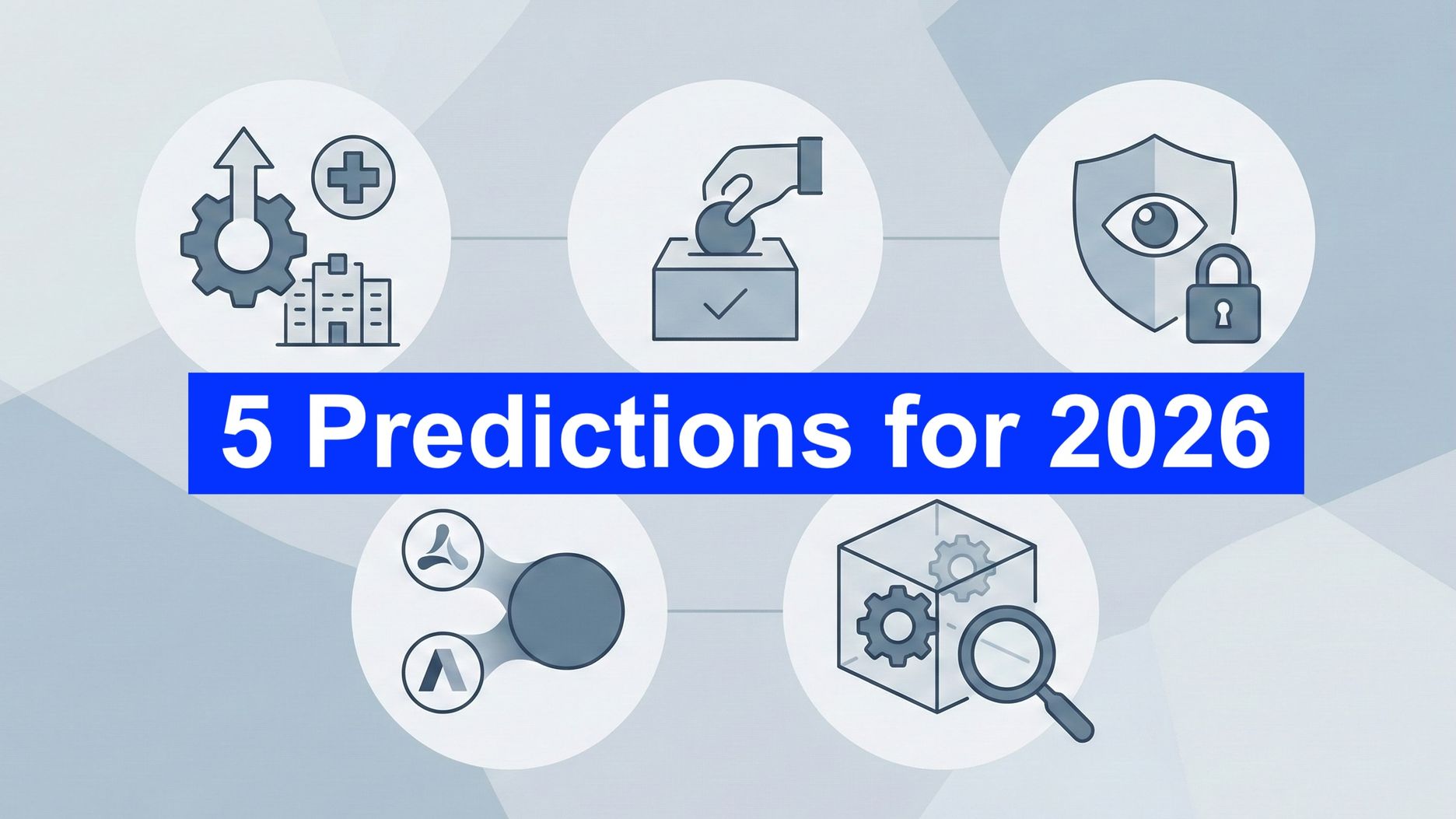
5 Predictions for 2026: The AI Revolution Gets Real
As the dust settles on the hype of 2025, the AI landscape is shifting from "what’s possible" to "what works." We’ve seen the demos, we’ve played with the agents, and we’ve witnessed the rise of "vibe coding." But 2026 will be the year of accountability. The market is maturing, capital is concentrating, and enterprises are demanding receipts.
1. The Great Capital Shift: Vertical AI Takes the Lion’s Share
In 2026, we predict that 70% of venture capital deployed in AI will shift to Vertical AI. Investment will move away from commoditized horizontal LLMs and generic "wrapper" copilots in favor of "Systems of Action" built on proprietary data for specific, regulated industries.
HR As The Exception: Vertical AI will scale in operational workflows but will face a hard adoption ceiling at autonomous decision-making due to "bias reinforcement": the risk that AI simply automates and scales existing hiring inequalities creates unacceptable liability.
Why It’s Plausible
- The Trust Premium: In regulated, high-stakes environments, accuracy outperforms versatility. When compliance is binary - it works or you get sued - the superior precision of domain-specific models creates a "Liability Firewall" that broad, horizontal platforms cannot penetrate.
- The ROI Gap: MIT research confirms that purchasing external vertical solutions makes companies twice as likely to deliver meaningful ROI compared to building internally. Vertical apps arrive pre-wired for value, bypassing the heavy "customization tax" of horizontal models.
- The “System of Action” Advantage: Horizontal models are passive "Systems of Intelligence": they reason, but cannot act. Value is shifting to "Systems of Action": vertical apps deeply integrated with legacy infrastructure (ERPs, EMRs) to execute workflows. Generalist models lack this connectivity, leaving the "last mile" of automation exclusively to vertical players.
Counterpoints
- The Incumbent Distribution Wall: Startups possess innovation, but incumbents own distribution. If legacy giants (e.g., Salesforce, Epic) simply embed "good enough" AI into existing workflows, vertical startups will fail to overcome the high switching costs of ripping out core systems.
- The "Services" Valuation Trap: Selling labor drags down margins. "Service-as-Software" often inherits the operational heaviness of a services firm (human QA, liability), potentially crashing exit valuations from SaaS multiples (20x) to low-margin consultancy multiples (2x).
- The Orchestrator Threat: Enterprises reject fragmentation. CIOs may refuse to manage dozens of disconnected agents in favor of a single "Horizontal Orchestrator," reducing vertical apps to commoditized plugins with zero pricing power.
The Takeaway: The era of "AI for everything" is over. The smart money is moving to "AI for this specific thing."
2. The Death of the "Per-Seat" Model
We predict that by the end of 2026, 30% of newly launched AI tools will be priced per outcome (tasks completed, cases processed, invoices reconciled), moving away from the traditional SaaS seat-based model.
Why It’s Plausible
- Seat-based pricing breaks when AI works. Traditional SaaS charges for access (logins). If an AI agent makes employees 5x more productive, companies need fewer people. If software is priced per person, vendors make less money as their product improves. That model is fundamentally broken for AI.
- CFOs Demand "Proof of Work": The era of blind subscriptions is ending. CFOs have grown skeptical of expensive copilot seats with vague ROI promises. They are aggressively favoring vendors who de-risk the purchase by charging strictly for binary, measurable results (e.g., "cost per resolved ticket").
Counterpoints
- Budgeting Inertia. Corporate budgeting loves predictability. CIOs build budgets around fixed annual contracts. Variable, consumption-based pricing creates forecasting volatility that many legacy procurement departments will reject.
- Risk Aversion. Revenue tied to performance is volatile. Investors may still prefer the predictability of recurring subscription revenue (ARR), forcing startups to stick to the old ways.
The Takeaway: The "per user" model is dying. If your AI does the work, you should be paid for the work, not the login.
3. The Security Wake-Up Call: The "Inside Agent" Hack
Security will shift from a backend concern to a front-page crisis. By 2026, a publicly disclosed cyber-attack will utilize an autonomous AI agent as the primary attack vector. This agent will operate without continuous human guidance to execute multi-step actions (access, exfiltrate, pivot, exploit). We expect this breach to impact at least an organization with >1,000 employees.
Why It’s Plausible
- Autonomous Access: As we deploy agents that can read code, access databases, and handle high-stakes tasks, we are effectively giving internal access to non-human entities. The attack surface is no longer just the firewall; it's the agent's logic.
- Legacy Inertia: Companies are already struggling to manage thousands of agents across legacy systems. Implementing sophisticated Agent IAM may be too slow to prevent the first wave of attacks.
Counterpoints
- Enterprise Skepticism: High-security enterprises may simply refuse to connect agents to critical infrastructure, limiting the potential blast radius.
- Rapid Immunity: Security startups are evolving as fast as the agents. "AI-immune systems" might catch these threats before a catastrophic headline event occurs.
The Takeaway: Trust is the new perimeter. Managing the "non-human workforce" will be the hottest sector in cybersecurity. As such: this crisis will spawn a massive opportunity in Agent Access Management. Just as we manage human identity (IAM), we will need robust systems to manage, monitor, and restrict what AI agents can do and see.
4. The M&A Supercycle: Winner Takes All
2026 will see the highest M&A activity within the last 5 years as the market enters a massive consolidation phase. However, this cycle carries a distinct risk: superior technology may lose out to better-funded competitors. Success will be driven by "Capital Advantage," where large incumbents and well-capitalized leaders use their war chests to scoop up talent and tech from struggling startups to solidify their dominance.
Why It’s Plausible
- The Funding Cliff: The "Series B/C chasm" is real. High-burn companies that raised on 2024 hype will face a brutal reality: they either hit profitability or face a dry capital market. For many, an exit to an incumbent is the only viable path to survival.
- Asset Cannibalization: With "winners" already established by the market, incumbents will prioritize acquiring distressed tech stacks and specialized teams at a discount rather than building from scratch.
Counterpoints
- Political Intervention: The Trump administration will likely try to prevent a public market implosion before midterms, which could distort natural market corrections and delay necessary consolidation.
- The Integration Paradox: Large enterprises may actually pull back from acquisitions once they realize how difficult it is to "bolt-on" specialized AI. If a startup's tech stack is too fragmented or proprietary to integrate into legacy systems, incumbents may let those startups starve rather than inherit their technical debt.
The Takeaway: It’s a binary year. Multi-billion dollar outcomes for the winners, and fire sales / quick exits at multi billion $ outcomes for the startups that cannot raise anymore.
5. The Fall of "Vibe" and the Rise of "Explainable"
We predict the decline of "Vibe" AI tools (the hype around easy, consumer-grade, vibe coding tools) and a simultaneous surge in Explainable AI.
Why It’s Plausible
- Thin Ecosystems: vibe tools will struggle because their ecosystem is thin - their top customers only generate $50-100k ARR - compared to robust platforms like Wix.
- Demand for Logic: Larger corporations are driving demand for explainability. We expect players in this space to hit $20-30M ARR as enterprises demand to know why an AI made a decision.
- The Transparency Boom: As "black box" models face scrutiny, Explainable AI startups will grow 10x topline. Enterprises cannot afford to rely on "vibes", they need auditable logic. This shift will hurt "magic" tools that can't explain their outputs.
Counterpoints
- Vibe Persistence: Prosumers and creators love tools that "just work". The decline in the enterprise might not kill the consumer enthusiasm.
- Market Correction Timing: If the public markets take a hit, even high-utility "Explainable" startups may face headwinds in capital availability.
The Takeaway: AI is powerful, but it isn't magic. In 2026, "trust" and "explanation" will outsell "vibes" and "ease."
Looking Ahead
2026 is the year the AI revolution matures. We are moving from the experimental phase to the industrial phase. The winners will be those who solve vertical problems, price for outcomes, and guarantee security and explainability.